
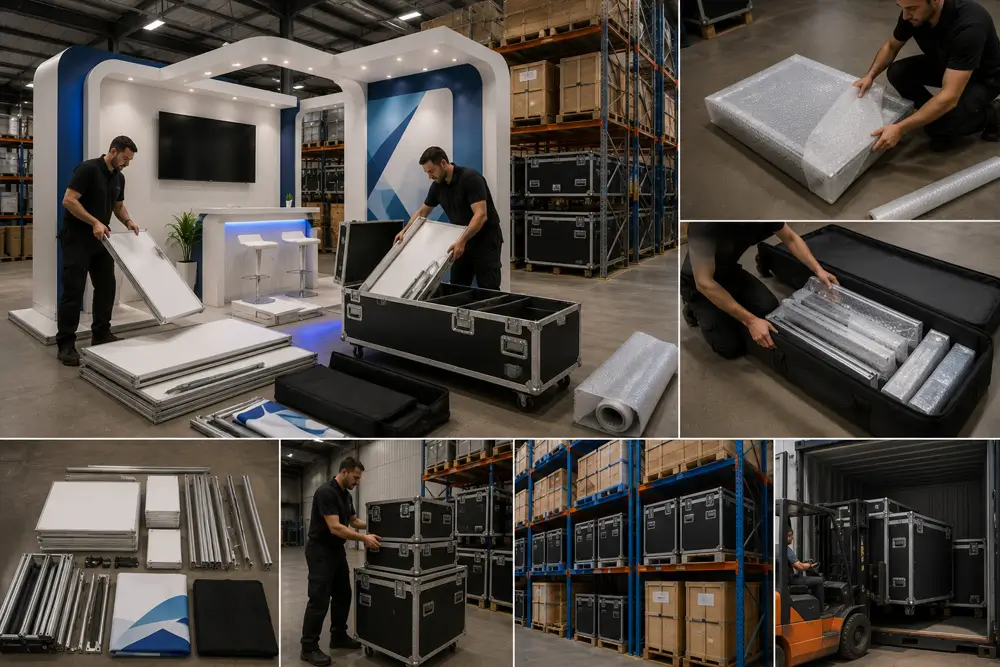
A well-designed exhibition stand is a significant asset. How you pack, transport and store it between events determines how long it retains its quality and whether it is ready to perform at the next show without costly repairs or replacements.
Poor packing and storage is one of the most common causes of stand deterioration. Damaged graphics, bent aluminium frames, cracked panels and lost components all result from careless handling and inadequate storage. This guide covers the practices that protect your investment.
Bump-Out: The Most Damage-Prone Moment
More damage happens to exhibition stands during bump-out than at any other point in the event cycle. The reasons are consistent: the team is tired, the venue is giving everyone limited time to clear out, adjacent exhibitors are rushing, and the adrenaline of the show has passed.
Brief your team on careful disassembly before the show closes. Rushing a disassembly to catch a flight is a false economy if it results in a damaged graphic panel, a bent frame member or a lost component bag.
Component Labelling and Inventory
Every component of your stand should be labelled before the first event it attends. Aluminium frame members, panel units, cable trunking, fixings, and accessory bags should all carry a label or tag that identifies them as part of your stand.
Maintain an inventory list of all stand components. After every event, check the packed stand against the inventory. Missing components are far easier to source when identified immediately after an event than when you are setting up three months later.
Packing Cases and Transport Containers
Invest in quality packing cases appropriate for each stand component. Aluminium flight cases, corrugated cardboard custom-fitted boxes, and padded fabric bags all serve different components appropriately.
Graphic panels and printed fabric should be packed to avoid creasing, puncturing or contamination. Rigid printed panels should be sandwiched between protective foam layers. Fabric panels should be rolled around a core rather than folded to avoid permanent crease lines.
Frame components should be packed in bundles with protective wrapping around connectors and ends to prevent scratching or deformation.
Graphics Care and Storage
Printed graphics are often the most expensive component per square metre of your stand. They are also the most visible indicator of stand quality.
Fabric graphic panels should be stored flat or loosely rolled in a clean, dry environment. Avoid tight folding as fold lines in fabric become visible at stand. Clean fabric graphics with a damp cloth if soiled; do not use solvents.
Rigid PVC or aluminium-backed panels should be stored vertically in protective sleeves or stacked flat with protective interleaving. Avoid stacking heavy items on top of printed panels.
Storage Environment
Exhibition stand components should be stored in a clean, dry, temperature-stable environment. Extreme temperature fluctuations can cause adhesive graphic films to delaminate, aluminium profiles to accumulate condensation and corrosion, and timber components to expand, contract and warp.
A climate-controlled warehouse or a dry indoor storage area is ideal. Vehicle storage or unventilated shipping containers in direct sunlight are unsuitable for long-term component storage.
Maintenance Between Events
Use the period between events to address maintenance tasks. Touch up any paint chips or surface damage on timber or steel components. Replace graphics panels that have developed visible wear or damage. Service any mechanical or electrical components like retractable banner mechanisms or LED light fittings.
A stand that goes to each event in the same condition as it left the last event maintains its quality over time. A stand that accumulates small damage without repair progressively degrades.
When to Store vs. When to Transport
If your next event is within two to three months, consider whether it is more cost-effective to store the stand at or near the next event venue rather than returning it to your home city.
For companies that exhibit regularly in a particular city, local storage eliminates return freight costs and simplifies bump-in logistics for subsequent events. Many exhibition stand builders offer storage services. Exhibition stand hire and storage
Frequently Asked Questions
How should I store exhibition stand graphics?
Fabric graphics should be rolled or stored flat in a clean, dry environment. Rigid printed panels should be stored vertically in protective sleeves or flat with interleaving. Avoid folding, stacking without protection, or exposure to humidity and temperature extremes.
How long does a well-maintained exhibition stand last?
A quality modular aluminium stand with good maintenance can last 10 years or more. Graphics panels typically need replacement every 2-4 years depending on event frequency and storage conditions.
What is the best way to transport exhibition stands interstate?
Road freight in appropriate packing cases is the standard approach. Air freight is available for urgent or lightweight stands. Purpose-built road freight using exhibition logistics specialists provides the best care for fragile stand components.
Should I use professional packers for my exhibition stand?
For large or complex stands, professional bump-out staff from your builder or an exhibition services company ensures correct disassembly and packing. For smaller modular stands, a trained team member can handle this effectively with good component labelling and inventory systems.
What happens to the stand components that are no longer needed?
Quality aluminium and steel components can be sold or repurposed. Printed graphics can often be recycled through large-format printing recycling programmes. Some builders offer take-back or refurbishment services for older stand components.
Can my exhibition stand builder store my stand between events?
Many builders offer storage as a service. This is particularly convenient for companies that exhibit in the same city as their builder. Brij & Co can advise on storage options as part of our post-event service. Contact Brij & Co
Protect Your Exhibition Investment
A well-packed and properly stored stand retains its quality across many events. Brij & Co can advise on best practices for your specific stand system and components. Contact us to discuss your storage and logistics requirements.