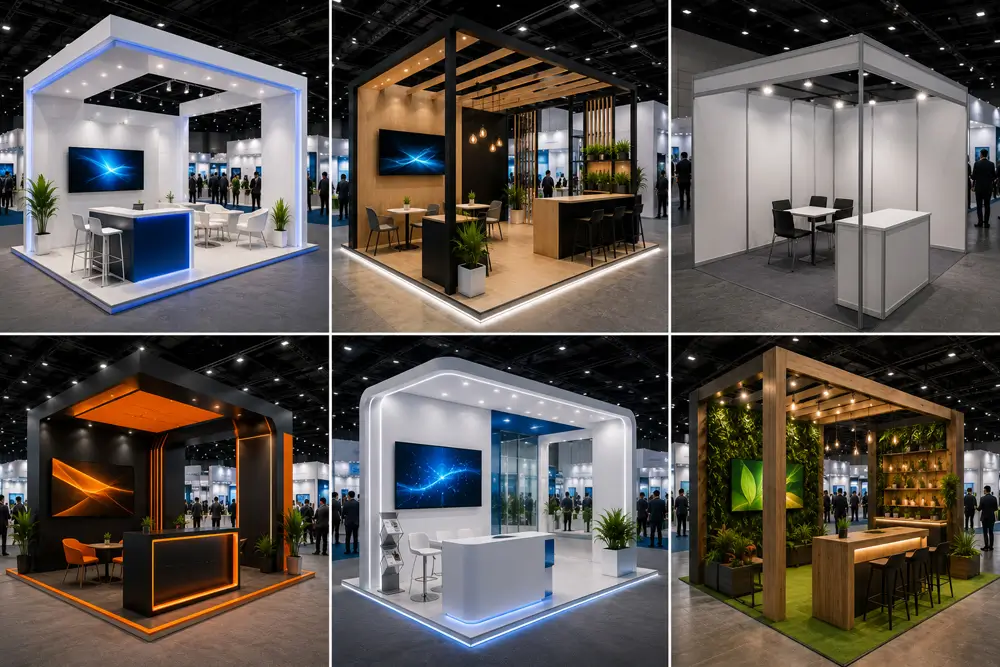
The term ‘exhibition stand’ covers an enormous range of display formats. A pull-up banner at a conference registration desk and a three-storey double decker island at a mining conference are both exhibition stands. The right type for your situation depends on your event format, your floor allocation, your audience and your budget.
Here’s a complete guide to every stand type available in the Australian market, with guidance on when each is the right choice.
Shell Scheme Stands
A shell scheme is the basic stand system provided by event organisers as part of your floor space booking. It consists of aluminium extrusion frames with white or grey infill panels, a standard fascia board with your company name, and a basic power point. It’s included in your stand booking fee or available at a small additional cost.
Shell schemes are the right choice when your budget is genuinely limited and you’re new to exhibiting. They become a liability when every competitor around you has invested in a custom or upgraded display, because the visual contrast works against you. Many brands now add shell scheme upgrades (custom wall graphics, branded counter, lighting) to differentiate within the shell scheme format.
Pop-Up and Pull-Up Stands
Pop-up displays and pull-up banners are portable, fast-assembly display systems that pack into cases or bags. A pull-up banner is a single graphic cassette that extends to 2 metres tall and comes in widths from 600mm to 1500mm. Pop-up fabric wall systems create a 2-3 metre wide curved or straight branded backdrop using an aluminium frame and a dye-sublimation fabric graphic.
These systems are best for small footprints (3×1 or smaller), conference sideline exhibits, registration displays and supplementary branding within larger stands. For a primary exhibition stand at a national trade show, a standalone pop-up system is usually insufficient.
Inline Stands
An inline stand has one open face (the aisle-facing side) and is bounded by other stands on the remaining sides. The most common format is 3×3 (9 sqm). Inline stands suit exhibitors with limited budgets who want a professional custom presence without the complexity or cost of a multi-sided stand. Visual impact is concentrated on the single open face.
Peninsula and End-Cap Stands
A peninsula stand is open on two or three sides and positioned at the end of a row. The extra open faces allow broader visual presence and more natural visitor access. Peninsula stands deliver more impact per dollar than equivalent inline stands because the additional frontage exposes the stand to more visitor traffic. Common sizes are 3×6 and 6×6.
Island Stands
An island stand is open on all four sides and positioned in the centre of the exhibition floor. This is the format used for flagship exhibitions at major trade shows. Island stands start from 6×6 (36sqm) and range upward to 12×12 or larger for the biggest exhibitors. The all-round access creates maximum visitor flow but also requires more complex design to ensure consistent visual impact from every approach angle.
Modular Exhibition Stands
Modular stands use standardised structural systems that can be reconfigured for different footprints between events. They’re the most cost-effective choice for exhibitors who attend three or more events per year with varying floor plan allocations. Graphics update independently of the structure. See our full guide to modular vs custom stands for a detailed comparison.
Double Decker Stands
Double decker or two-level stands use a mezzanine floor to create additional usable space above the ground level. Upper levels are used for private meeting rooms, VIP areas or observation decks. Double decker stands require structural engineering certification and advance venue approval. They start from approximately 6×6 footprint and suit flagship exhibitors at annual industry events.
Outdoor Exhibition Stands
Outdoor stands are designed for open-air events including agricultural shows, food festivals, coastal activations and outdoor expos. They use weatherproof materials, UV-stable graphics, anchored bases and wind-rated structures. Standard indoor exhibition stand materials are not appropriate for outdoor use.
Frequently Asked Questions
Which type of exhibition stand offers the best value for money?
For a first-time exhibitor, a custom inline 3×3 stand offers the best value. For exhibitors attending three or more events annually, a modular system has the best lifetime return. For flagship annual events, an island or double decker stand delivers the highest brand impact relative to the competition.
What is the difference between space-only and shell scheme event allocations?
A shell scheme allocation includes the basic stand framework in your booking fee. A space-only allocation gives you a bare floor area with no framework included. Space-only is used for custom and modular stand builders who bring their own structure. Shell scheme is used by exhibitors who use the venue’s framework as their base.
Can I use a modular stand in a shell scheme allocation?
In most cases, yes. Modular stands can be built within shell scheme footprints, usually replacing the shell scheme infill panels with the custom modular structure. Some event organisers require you to accept the shell scheme framework even if you’re overlaying it with a custom system. Check with the event’s exhibitor services team.
Brij & Co designs and builds all stand types for Australian events. Contact us to discuss which format is right for your next exhibition.